Given the importance of wage bills to the likely success of football clubs, I thought that it would be interesting to look at wages for the Big 5 European leagues in the 2019/20 season (the most recently published accounts). Some thoughts in the following thread.
As a technical note, I have converted wages from Euro denominated leagues to GBP using the 1.14 exchange rate from the Deloitte Money League. To facilitate comparison, I have provided figures for each league in both Euros and GBP, though the overviews are only in GBP.
In England the highest wage bill in 2019/20 was #MCFC £351m, followed by #LFC £326m, #MUFC £284m, #CFC £283m, #AFC £225m and #THFC £181m. It is worth noting that some clubs’ figures were inflated by changing their year-end date, which meant the accounts covered 13 months. 


In Spain #FCBarcelona £389m and #RealMadrid £332m lead the way. There is a significant drop to #Atleti £199m, then another large gap to #SevillaFC £109m. Note: including other sports (basketball, handball, etc), total wages at Barcelona were £427m and Real Madrid £361m.


In Germany the #FCBayern £298m wage bill was by far the highest, over £100m more than the closest challenger #BVB £189m, followed by RB Leipzig £129m and Bayer Leverkusen £123m.


It’s a similar story in Italy, where the #Juventus £249m wage bill is significantly higher than the rest of Serie A. The next highest is #Inter £174m, followed by #Milan £141m, #ASRoma £136m and #SSCNapoli £123m, then a big gap to #Atalanta £61m.


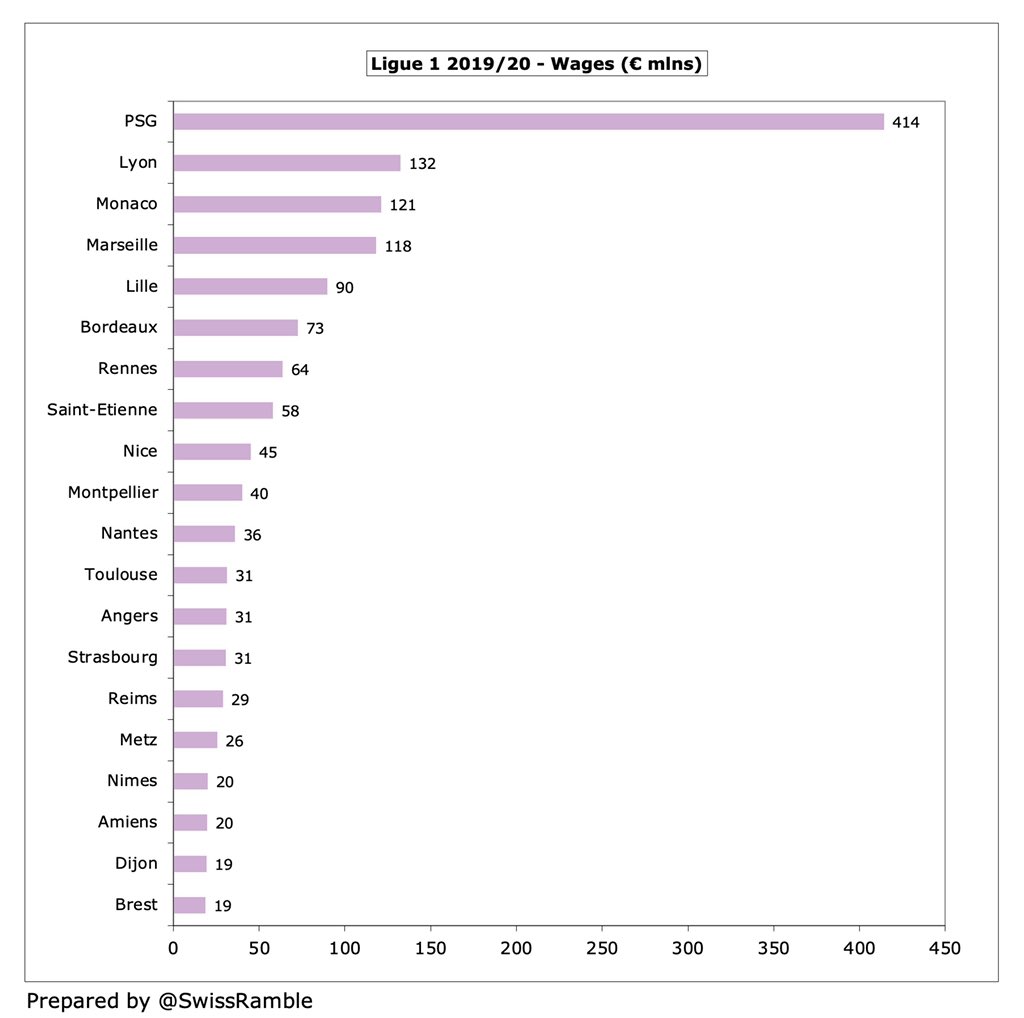
In France #PSG £363m wage bill represents 29% of the entire Ligue 1 payroll, an astonishing £247m more than the next highest, Lyon £116m. There are only two other clubs with wages above £100m, namely Monaco £106m and Marseille £104m. 12 clubs are below £50m.

By and large, Premier League clubs have higher wage bills than the other European leagues, though there are 2 Spanish clubs and 1 French club in the top 4 overall. Outside of England each country usually features 1-2 clubs with a significant wages advantage over the others.

However, the wages distribution in the Premier League is the most equitable with the top club paying only 4.5 times the amount of the bottom club. The differential is much higher in the other leagues with Ligue 1 “leading the way” (22x), followed by La Liga (17x).
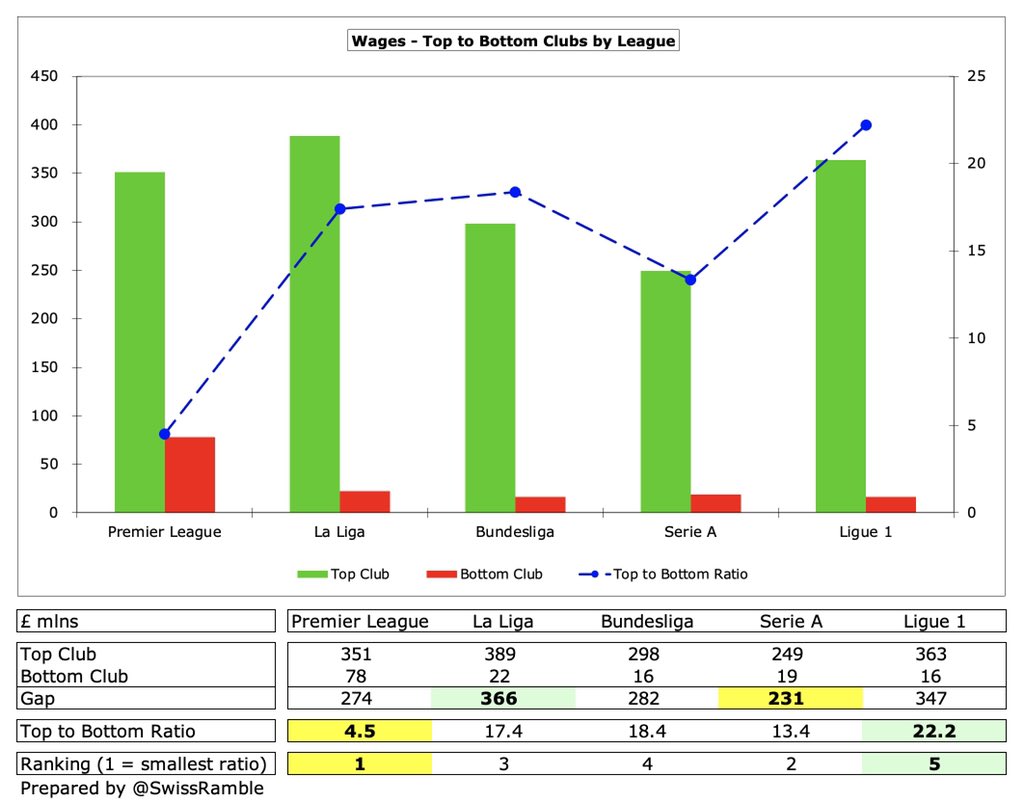
Looking at the wage gaps between the top club and second placed club, these are quite small in the Premier League £26m, La Liga £57m and Serie A £76m, though there are significant differences in Ligue 1 £247m and, to a lesser extent, the Bundesliga £109m.

On the other hand, the wages gap between the second and third placed clubs is smallest in Ligue 1 at only £10m with the largest difference found in the Bundesliga with a hefty £133m.

All leagues have a huge wages gap between their elite and the rest, as evidenced by the differences between the third placed and bottom club, which is at least £90m (Ligue 1). The gap is most pronounced in the Premier League at £206m, though the ratio is smallest (3.6x).

The strength of the English Premier League is evident when looking at average wage bills, where each club paid £162m on average. This was at least £72m more than La Liga £90m and Serie A £88m, while being over twice as much as the Bundesliga £72m and Ligue 1 £62m.

If we rank clubs from the Big 5 leagues by wage bill, the Premier League has no fewer than 9 of the top 20, though the highest are #FCBarcelona £389m, followed by #PSG £363m, #MCFC £351m, #RealMadrid £332m and #LFC £326m. #FCBayern are the highest German club with £298m.

There are another 10 Premier League clubs in the rankings from 21 to 40, which means that almost half of the top 40 European clubs in terms of wages come from England. In contrast, Ligue 1 has only 4 clubs in the top 40 (La Liga 5, Serie A 5 and the Bundesliga 7).

#SUFC were the only Premier League club outside the top 40 European wage bills, though they were higher than Villarreal, who won the Europa League in 2020/21, and Atalanta, who reached Champions League QF in 2019/20, and around the same as Lille, Ligue 1 champions last season.
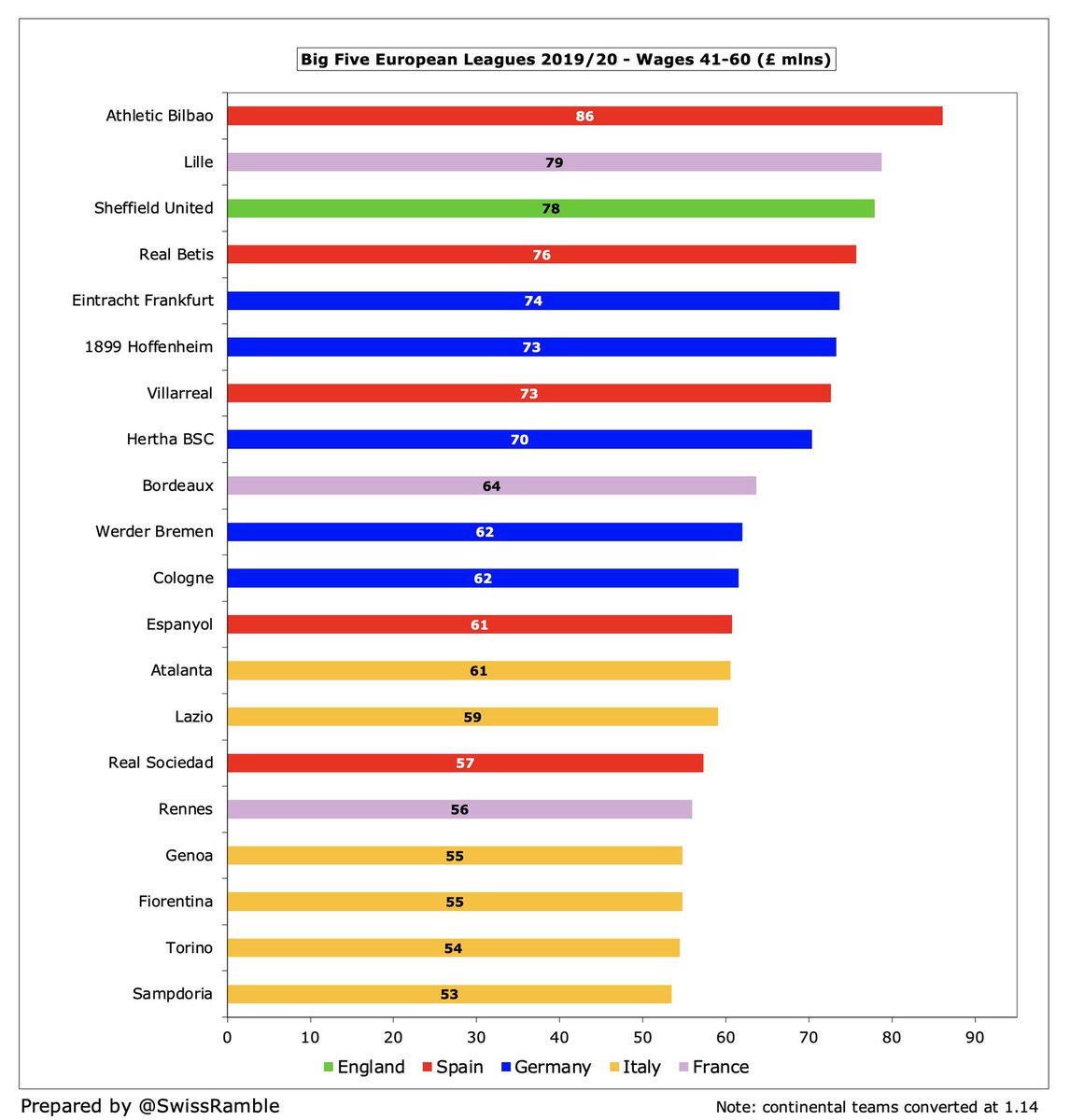
Excluding England, the wages rankings between 61 and 80 are split fairly evenly among all the Big Five European leagues: Spain 6, Italy 5, Germany 5 and France 4. However, even here there is a sizeable range between clubs from £51m to £30m.

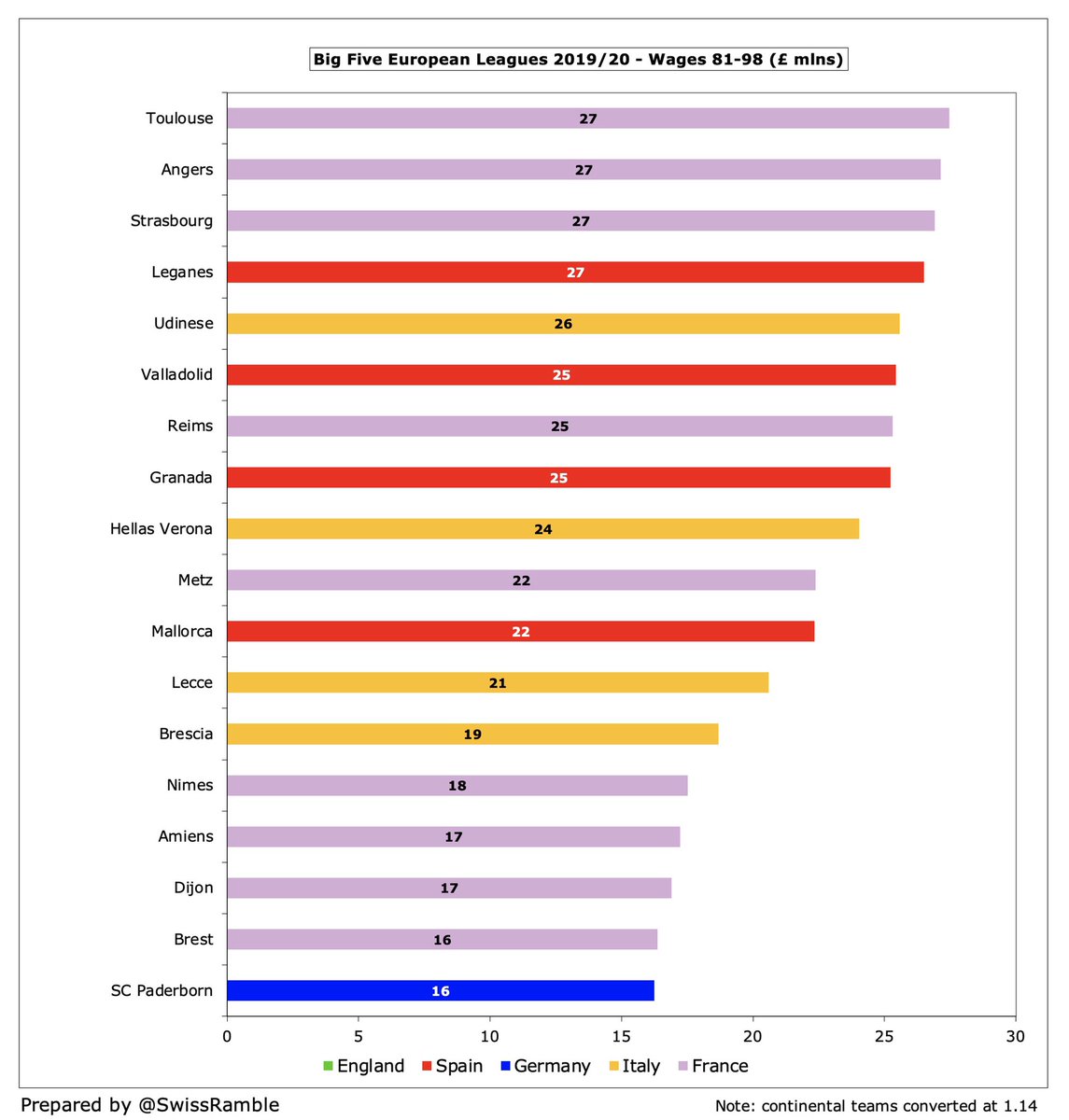
9 of the 18 lowest ranked clubs for wages in the Big 5 leagues were in France, though the smallest wage bill was in Germany with SC Paderborn £16m, just below Brest and Dijon. The lowest wages in Italy and Spain were Brescia and Mallorca with £19m and £22m respectively.
Wages are by no means the only driver of performance for clubs, but this is clearly one of the most important factors. Money on its own cannot buy success, but it sure helps in the world of football. There have been “exceptions to the rule”, though not many in recent years.
• • •
Missing some Tweet in this thread? You can try to
force a refresh