Tamil cinema has offered space for dissent in popular culture. It has tried to engage with the current politics and simultaneously questioned social constructs. Read this thread of readings from EPW on cinema and politics.
Most mainstream films that centre caste have, even if unknowingly, not understood the historical roots and cultural background of Dalits. Read B Prabhakaran: epw.in/journal/2021/5…
The notion of realism, ideology of uplift, and deployment of binaries (classical vs non-classical)-- all provided the Tamil elite with a new language to engage with cinema, in response to the arrival of Talkies, much enthused by the subaltern. epw.in/journal/2014/4…
Read the #EPWArchives on the reaction to Rajinikant’s entry into politics:
Rajinikant came out saying, “We will change everything.” A few political commentators believe that Rajini’s foray.. likely to shake up Tamil politics as MGR’s entry did in the 70s. epw.in/journal/2020/5…
This article draws attention to the refashioning of conventional cinema; focuses on two questions.
Does the idea of the "popular cinema" itself survive the end of the "great divide"?
Can it really assimilate the political charge of oppositional cinema? epw.in/journal/2014/3…
In this piece, the author argues that the incorporation of critical ideas on society and politics into the mainstream cinema reflects the diminishing potential of dissent in India, and is related to the rise of neo-liberalism and consumer culture. epw.in/journal/2014/1…
Political messaging in Tamil cinema captures activism, dissent and caste inequities with communist sensibilities. epw.in/journal/2018/3…
With movies like Sairat and Kaala, what does it mean in terms of representation and forging a path towards equality? Read "Bahujan Representation on the Big Screen- A Reading List." Free to access. epw.in/engage/article…
The box-office hit ‘Roja’ evoked in its audience a nationalistic fervour, as the female protagonist fights all odds to rescue her husband, kidnapped by Kashmiri militants. Read: How Mani Ratnam's Roja Made You an Unsuspecting Nationalist. epw.in/engage/discuss…
We hope you enjoyed this thread of readings on Tamil cinema and politics. You can access the EPW website with a subscription plan.
Digital access starts at Rs 770 per year. Find more details, here: bit.ly/epw-subscribe
• • •
Missing some Tweet in this thread? You can try to
force a refresh

#EPWConversations
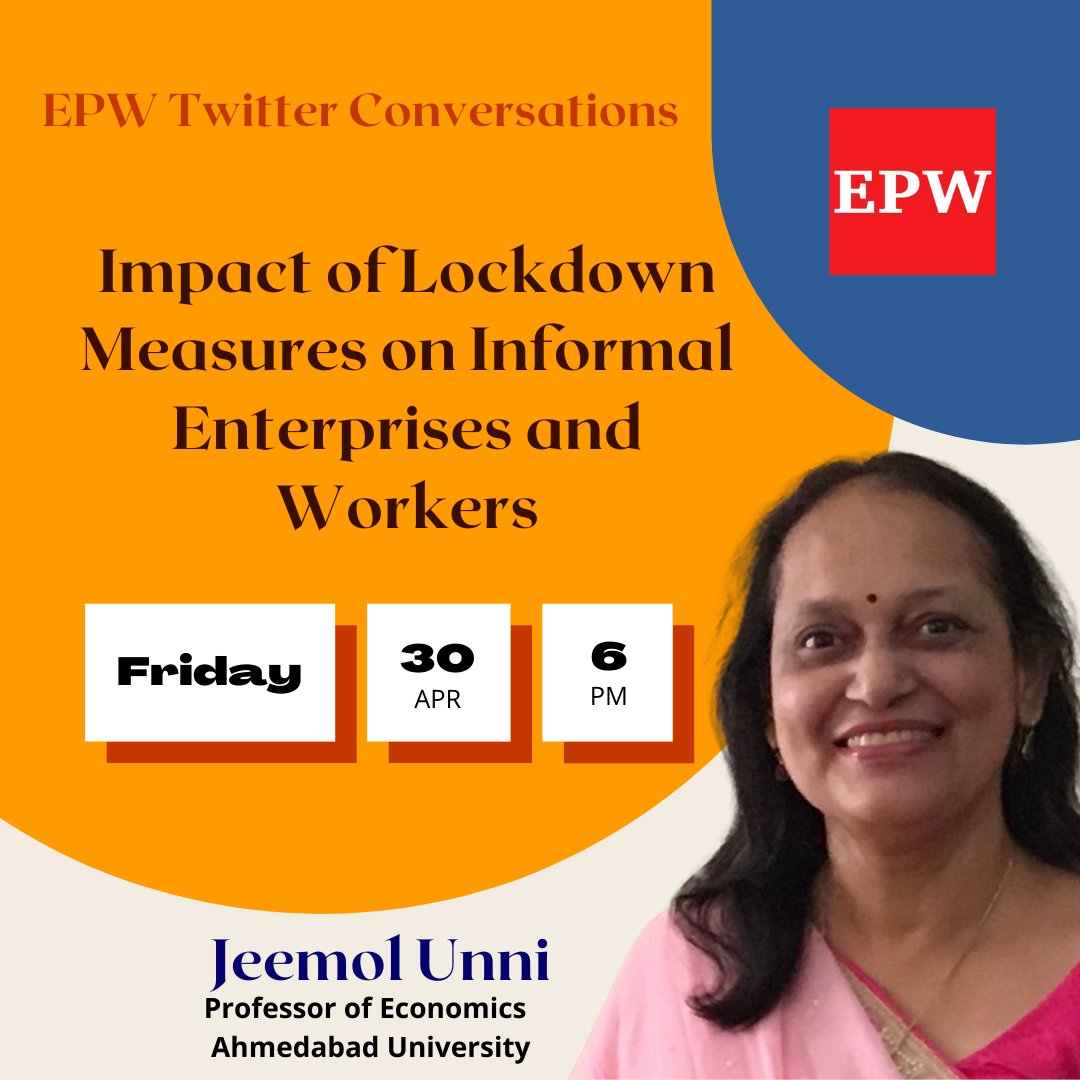
Did the #COVID19 lockdown relief measures help refigure the livelihoods of informal workers?
In this conversation #thread, professor @JeemolUnni
examines the impact of the lockdown on workers.
Join the discussion and send us your questions in the comments.
We are currently in the midst of the second wave of #COVID19 in India. People and the government are struggling with the public and private health system caving in.
The question before us for the second time in a year is to save lives and/or save livelihoods? | @JeemolUnni
The lockdown measure acted as a macroeconomic shock in 2020.
According to CMIE, an estimated 122 million people lost their jobs in April 2020 alone and three-quarters of these were small traders and wage labourers, mainly in the informal sector. | @JeemolUnni
The #COVID19 pandemic has triggered a global crisis, but its impact is not shared equally.
Social hierarchies, inequalities, and injustice reproduced during the pandemic have added to existing challenges faced by vulnerable categories of people. #Thread
The fear of contagion ignited by #Covid19 has renewed old associations between dirt, disease, and particular communities.
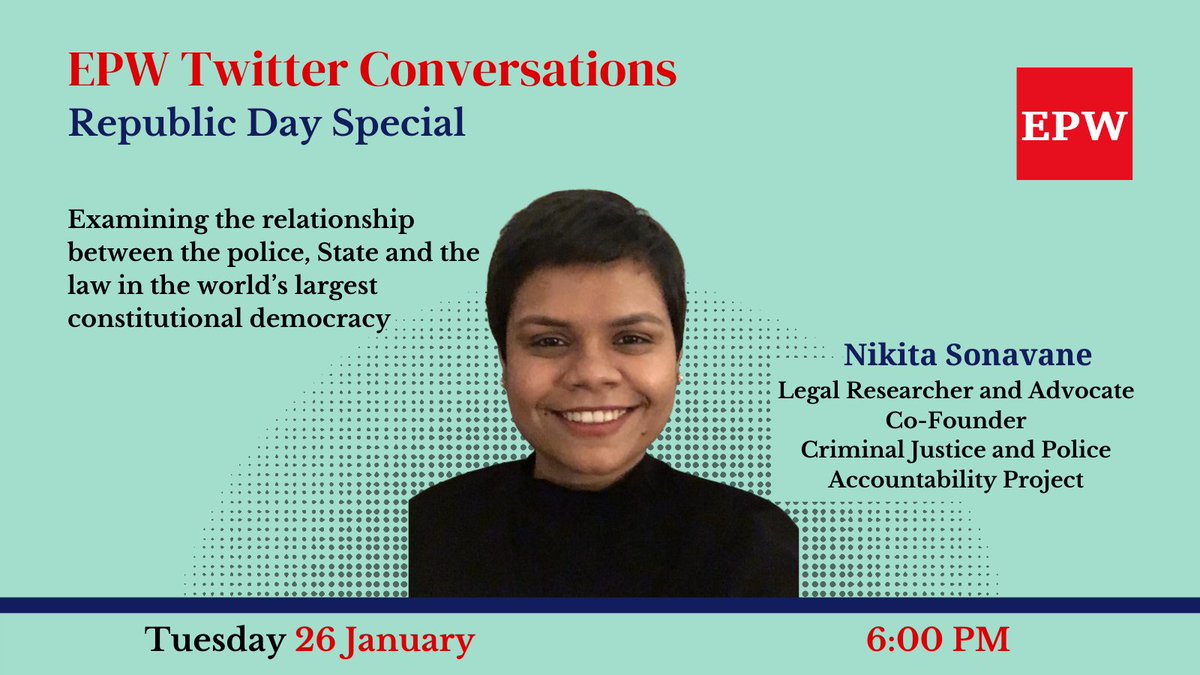
For the next hour, she will be discussing the relationship between the #police, #State and the #law.
Join the conversation and send us your questions in the comments section.
On #26January, 2021, the Indian republic completes 71 years since its formation; against the background of a global pandemic that has starkly exposed its fault lines. | @glorious_gluten
The 299 member #ConstituentAssembly was unique for there were 15 women (including a #Dalit woman Dakshini Velayudhan) who were voted to be a part of the
Committee and make their contribution to the building of the republic. #RepublicDay | @glorious_gluten
How was the #Constitution of India drafted?
This #RepublicDay, we revisit @epw_in articles that look at the debates and discussions involved in creating the framework for a democratic India. #26January
The Indian state was an amalgamation of separate, and distinct identities. Aditya Nigam writes that the Constituent Assembly provided ways for states to assert their selfhood within a united India, and thus included different regions in "nation forming." bit.ly/2QR8mvT
Vivek Prahladan writes that it was through B R Ambedkar's sustained efforts in the framing of the Constitution that the idea of democracy in India was made inextricable from policies of affirmative action. #RepublicDaybit.ly/2KW1lX3
#EPWConversations: We are live with @vabhis, and we invite you to send your questions about public transportation in India in this thread. He will be tweeting through EPW's account for the next hour.
Our cities happen to be the places where distortions of development are amplified and more visible. Transport and urban equity is one major indicator to assess this distortion. One class of cities (particularly, metropolitan cities) gets priority over the smaller cities and towns
Similarly, within the city and towns, the more affluent class gets priority over the poor and underprivileged ones. | @vabhis
Cars and two-wheelers constitute 85% of vehicles on roads but only 29% of overall trips in India.
@vabhis explains how most of the urban poor cannot afford even the most inexpensive motor vehicles. Yet, they bear the maximum brunt of road accidents and vehicular air pollution.
Rapid urbanisation and haphazard planning have had disastrous consequences for urban poor, leaving them without proper access to employment, education and urban services.
Cities have become an exclusive space for the elite and white-collar workforce, writes @vabhis.
Be it Mumbai's expensive Bandra–Worli sea link that caters only to cars or Ranchi's failure to fix its bus transport system, @vabhis finds that, in metros and non-metro cities alike, urban mobility has neglected the needs of poor commuters.