New @VOX_Pol publication w/ @jonmbright: “Extreme Digital Speech: Contexts, Responses, and Solutions”: voxpol.eu/new-vox-pol-re…
The following thread summarizes the topics of each section… /1
The following thread summarizes the topics of each section… /1
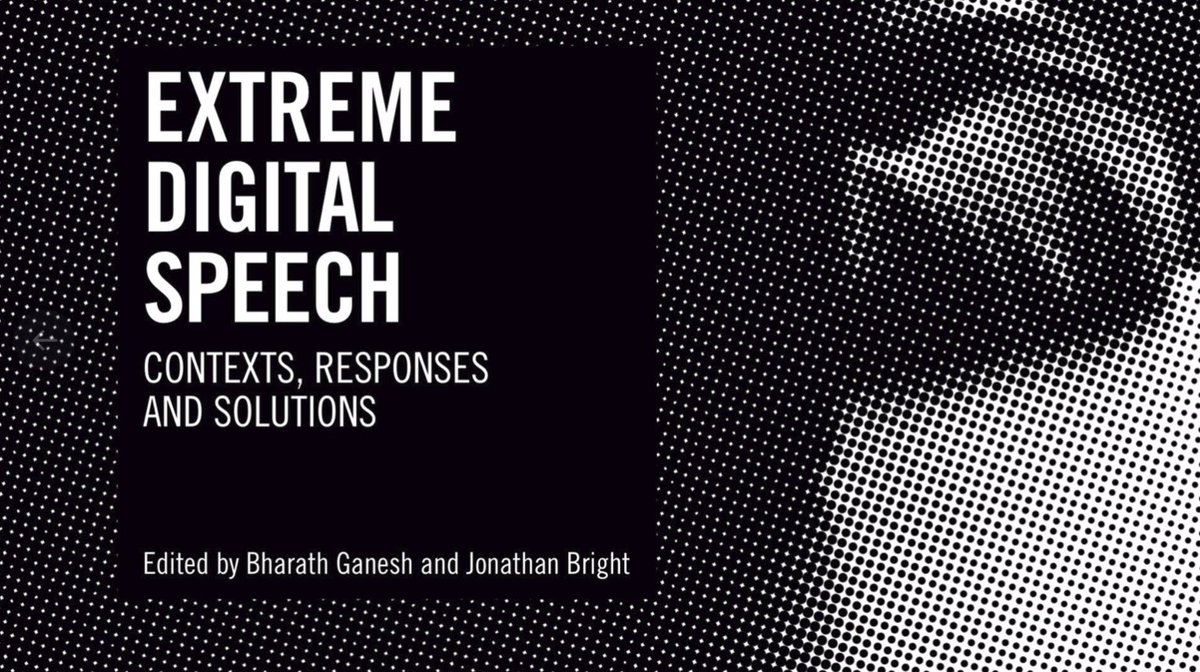
In the report, we explore extreme digital speech (EDS) as a challenge that requires co-ordination between governments, civil society and the private sector. Part 1 contextualises EDS, and Part 2 looks at responses to it /2
To define extreme digital speech, @objetpetitm starts us off by encouraging us to look at cultures that enable extremism online, and the challenges this raises for policy /3
Turning to jihadism, @LoBindner and @einfal walk us through different stages of jihadist extreme digital speech, focusing on propaganda on the surface web and the use of encrypted messaging /4
I consider three configurations of the far right online, exploring webforums and virtual community, political blogs, and social media. I propose ‘swarms’ as a useful metaphor to think about far right extreme digital speech /5
What can case studies of terrorists tell us about the effects of EDS? @MubarazAhmed looks at jihadist and far right terrorists and tells us that we can’t draw causal links, but need to think on a case-by-case basis /6
In Part 2, @john_gallacher1 provides a primer on applications of AI in the field of counter-extremism, giving an approachable overview of techniques and the limits of technological solutions /7
Internet Referral Units run by police forces play an important role in content moderation. @ZoeyReeve describes London’s Met Police’s CTIRU and its use of human assessment and crowdsourced flagging of extreme content /8
In the next section, @ValentineCrst outlines key actors in government and the private sector involved in decisions to remove and block content /9
I argue that counter-narratives are too reliant on marketing data and allow us to sideline important questions about content regulation. While they are important, I argue they are at best limited in their potential /10
Looking at informal voices, @kcoyer argues that individual creative acts not associated with funding from government or platforms might be more effective in delivering counter-narratives /11
BONUS: for a longer read on that issue, check out our reviewer's article @nebulon82 on this with @policyinternet
onlinelibrary.wiley.com/doi/full/10.10… /11.5
onlinelibrary.wiley.com/doi/full/10.10… /11.5
Finally, @huwcdavies argues that narrow formulations of digital literacy are limited in countering EDS. He argues digitally literate thinkers must be "motivated to challenge their own thinking and positionality" /12
THANKS: @jonmbright and I are grateful to all the authors and the feedback provided by @joel_busher, @nebulon82, and two anonymous reviewers + the support of @VOX_Pol and @oiioxford as we produced this report /END