All right, y'all, I have come here to tweetstorm and chew bubblegum. And I'm all out of gum.
This week's column is on whether we've basically won the war on poverty.
washingtonpost.com/opinions/did-w…
As always, you need to read the column for its argument; here I just answer questions
This week's column is on whether we've basically won the war on poverty.
washingtonpost.com/opinions/did-w…
As always, you need to read the column for its argument; here I just answer questions
Question 1: Okay, this is less of a question, per se, and more of a rant about how libertarians are heartless and don't understand how hard it is to be poor.
Answer: My friend, you should try reading the column, rather than glancing at the headline and inferring its argument.
Answer: My friend, you should try reading the column, rather than glancing at the headline and inferring its argument.
Seriously, I put 750 words all in a row for your reading pleasure. Not all of those words are prepositions or quirky adjectives. In sum, they are much more informative and interesting than a seven word headline. It is very hard to compress an argument into seven words.
I realize reading the column would leave somewhat less scope for your imagination than just making up something to argue with. And look, imagination is what separates us from the apes. I don't want to discourage anyone from creative endeavors. But have you tried macrame?
Okay, I feel better now.
Question 2: Why didn't you mention [insert name of study that someone thinks is very important to the discussion]
Answer: As I mentioned above, I have 750 words. In that space, I have to communicate some facts, argue with some propositions, and charm you with my adjectives.
Answer: As I mentioned above, I have 750 words. In that space, I have to communicate some facts, argue with some propositions, and charm you with my adjectives.
I am not writing a book-length monograph on poverty. I'm writing a 750 word column, and hence, have to trim down to things that can be argued at that length.
If you think that there is a good 750 word column out there which 1) holds a reader's interest 2) makes an argument and 3) engages with all the stuff you think I EGREGIOUSLY left out, I encourage you to write it. Wordpress will give you a blog for free.
When you are done, please email me the link. I'm always eager to learn.
Question 3: (Assorted people taking issue with the below quotation. How could I be so insensitive to the plight of poor graduate students?
Answer: I *was* a poor graduate student.
Answer: I *was* a poor graduate student.
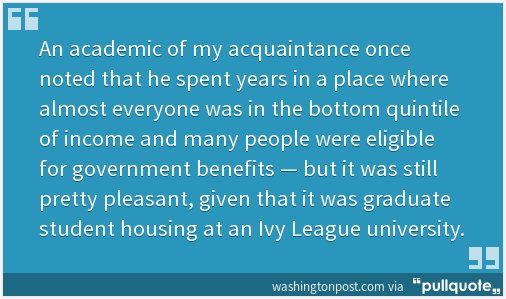
And because professional school loans are breathtakingly larger than some piddling little loan to cover living expenses, I got to spend years after grad school living on a disposable income in the low hundreds. I am *exquisitely* sensitive to the plight of folks in this position.
But this is not a social problem. Virtually everyone in graduate school has a lot of academic ability, a sizable heaping of social capital, and career alternatives to working as a janitor for the rest of their life. They're going to be okay. Their kids are going to be okay.
I realize that it feels very not-okay when you are 35 years old and eating ramen and cheez-whiz surprise, the surprise being that you're still eating ramen and cheez-whiz at the age of 35. But being broke is very different from intergenerational poverty.
Question 4: Conservatives who want me to say the answer is culture feuding with liberals who want me to say the answer is hog-wild government spending.
Answer: If I knew the answer, I definitely would have mentioned it.
Answer: If I knew the answer, I definitely would have mentioned it.
Yes, culture is obviously a component of poverty, which is why we worry about high-poverty neighborhoods. Do you know a way to change culture through government fiat? I don't.
Okay, actually, I do, but the communist and theocratic regimes that use those methods are pretty ugly
Okay, actually, I do, but the communist and theocratic regimes that use those methods are pretty ugly
On the other hand, we've spent a lot on high-poverty schools over the years, with very little to show for it. Maybe we needed to spend more--but at some point, you have to account for the fact that every incremental addition of funds so far has shown basically zero results.
You can't simply presume a threshold effect by which further spending would suddenly turn the trick, without considering the null hypothesis that no amount of money we poor into those schools is going to fix the inequities.
The evidence is very marginally better for intensive efforts to break up high concentrations of poverty by moving housing subsidy recipients into middle class neighborhoods. But the data is thinner than advocates admit, and the political lift on this one is enormous.
That doesn't mean I think we shouldn't keep trying. It means we have to admit that the easy intuitive stuff has failed at one level or another, and we need to admit that before we simply decide the problem is insufficient money poured into fixing high-poverty schools.
Right now all I am confident about doing is framing the problem. Solving for the answer will have to be left for another day.
Which brings us to the end of this tweetstorm. Don't forget to read the column: washingtonpost.com/opinions/did-w…
-- 30 --
Which brings us to the end of this tweetstorm. Don't forget to read the column: washingtonpost.com/opinions/did-w…
-- 30 --