5 years + 5 days ago, Minsk II, a deal aimed at ending the war in east Ukraine, was signed. I was supposed to tweet about the anniversary, and I’m doing it now, for my 5 devoted followers. LONG THREAD.
As you may know, there’s still a war here. The country’s industrial powerhouse, previously its most densely-populated area, has a 400+ km frontline running through it, pockmarked with trenches and heavy weaponry.
The region- known as Donbas, although even the name is controversial in Ukraine - is now divided into Russian-backed separatist enclaves, extending from the east and south of the frontline to the Russian border, and government-held areas to the west.
The “line of separation” cuts through areas that were once tightly interwoven. Western suburbs of Donetsk, Luhansk, and Horlivka are cut off from the cities their residents used to - and often still - gravitate to.
Ukraine’s previous president, chocolate magnate Petro Poroshenko, signed Minsk II at virtual gunpoint, as Russian regular forces led a separatist assault on pro-government troops at the strategic town of Debaltseve.
Minsk II put an end- sort of - to the "hot" stage of the fighting, which had killed over 5,000 by then. Yet none of its provisions have been fully implemented.
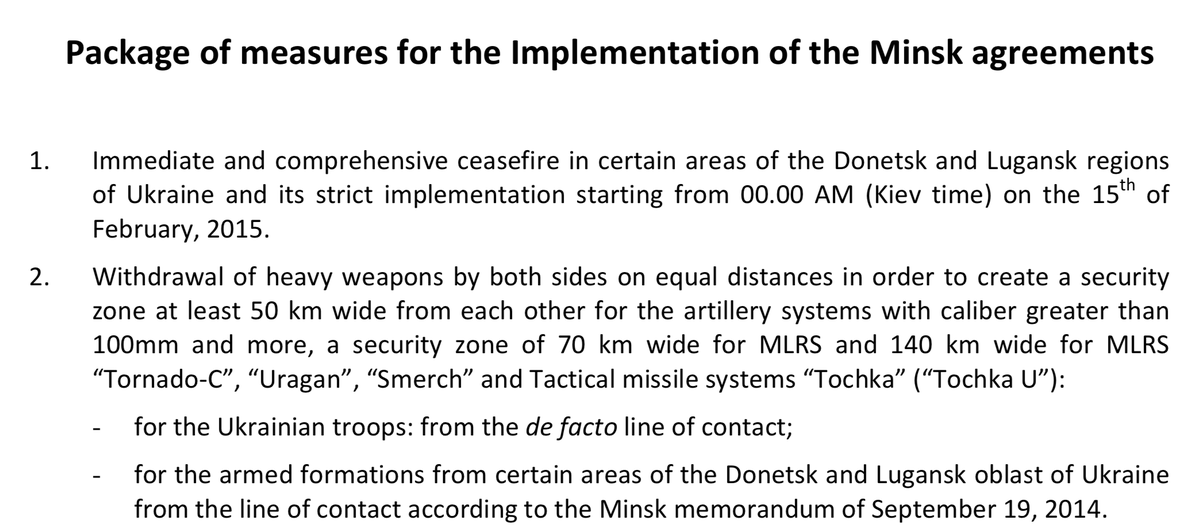
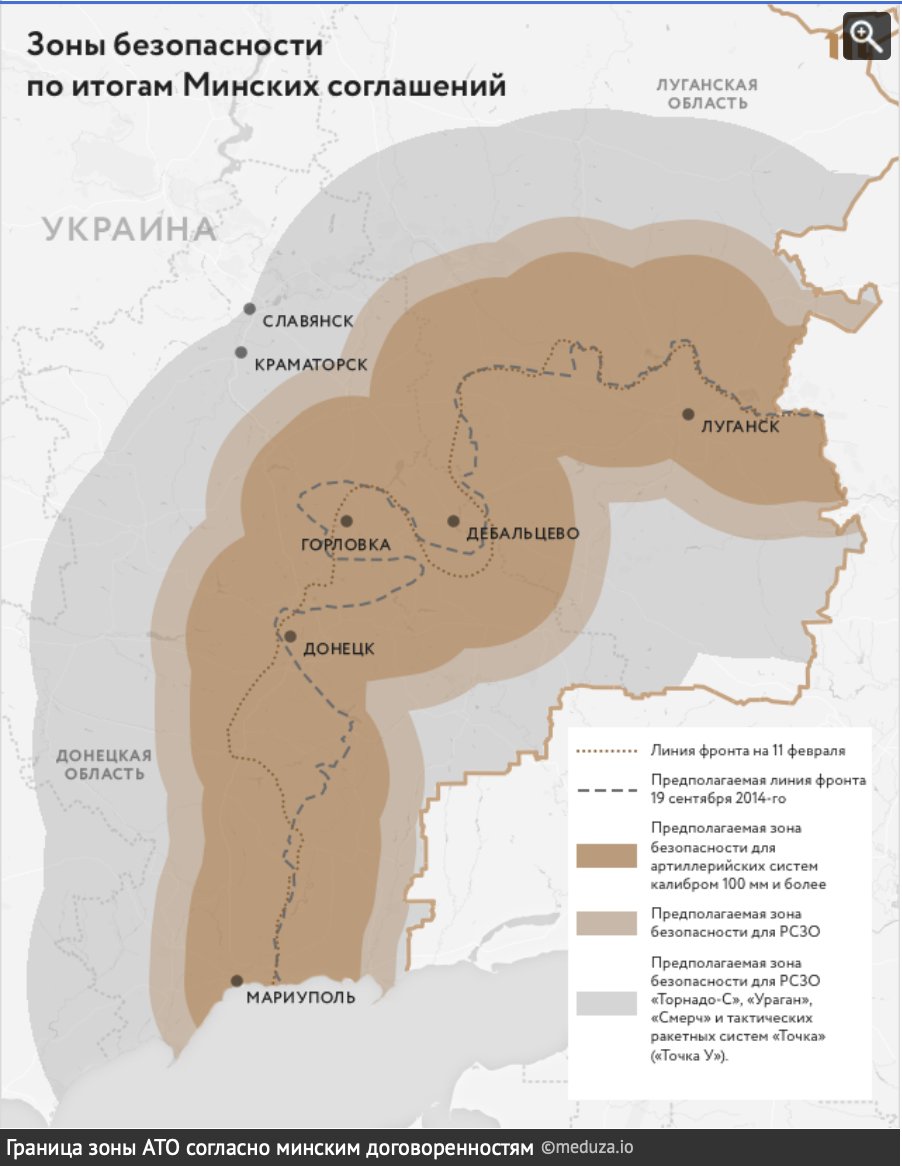
Minsk II says the sides need to withdraw to their September 2014 positions - to where they were before the separatists seized a whole bunch more territory by February. The separatists refused, and have been at their February 2015 positions ever since.
Even the letter of Minsk is flawed: it says UA resumes control of its eastern border with RU only after Kyiv holds elex in what are now the sep areas, and recognises them as autonomous districts of UA. How do you hold elex w/ a hostile force controlling the border, Kyiv asks?
The significance of these 2 issues – the separatists' flouting of the 2014 withdrawal lines, and Minsk’s border provision, can’t be overstated. They weigh on Kyiv in all negotiations. This map, from @meduzaproject, shows gap btw de facto and de jure withdrawal lines. 
The sides are now trying to agree on disengaging forces along the frontline, where they are often less than 1km apart. Disengagement is hard for many on UA side to swallow when pro-RU fighters are already so far forward of the 2014 line.
And disengagement is even harder to swallow for many given the absence of a game plan for Kyiv to get the border back ahead of elections.
President Ze may hope to re-negotiate Minsk’s border provision to allow for at least partial UA control before any elex in sep areas. If this succeeds, could it alter views on disengagement? It’s uncertain- but it’s also not clear whether Ze’s efforts have real traction.
The fact that RU denies being party to the conflict complicates negotiation efforts. It claims to be a mediator, insisting Kyiv should negotiate directly with the seps. Kyiv refuses, on the grounds that they're merely Russian proxies.
This lends a "fun" dynamic to meetings of the Trilateral Contact Group in Minsk, where the sides seek to manage day-to-day humanitarian/security issues, and to advance a sustainable settlement.
UA reps talk amongst themselves when the seps present their vision of events. RU representatives, confronted with issues like ceasefire monitors' lack of access to the separatist-held territories, say it's none of their business.
That's not to say the seps' aims don't differ from those of their Kremlin sponsors. They do. They want to integrate with Russia. Russia wants to at least appear to pursue the aims of Minsk II - to integrate the sep areas back into Ukraine.
In Oct 2019, when the sides agreed to the Steinmeier Formula, which calls for Kyiv to recognize these areas as autonomous entities w/in Ukraine following elex under Ukrainian law, "Donetsk People's Republic" rep Natalia Nikonorova supposedly cried. She felt betrayed by Russia.
Of course, there is no clear path to holding elections under Ukrainian law in areas where Ukrainian law doesn't function, so the current focus is on a more modest goal: ensuring a sustainable ceasefire - finally.
If we understand "ceasefire" to mean, well, ceasing fire, then neither side has abided by the ceasefire day to day. From the OSCE, on 2019 violations:
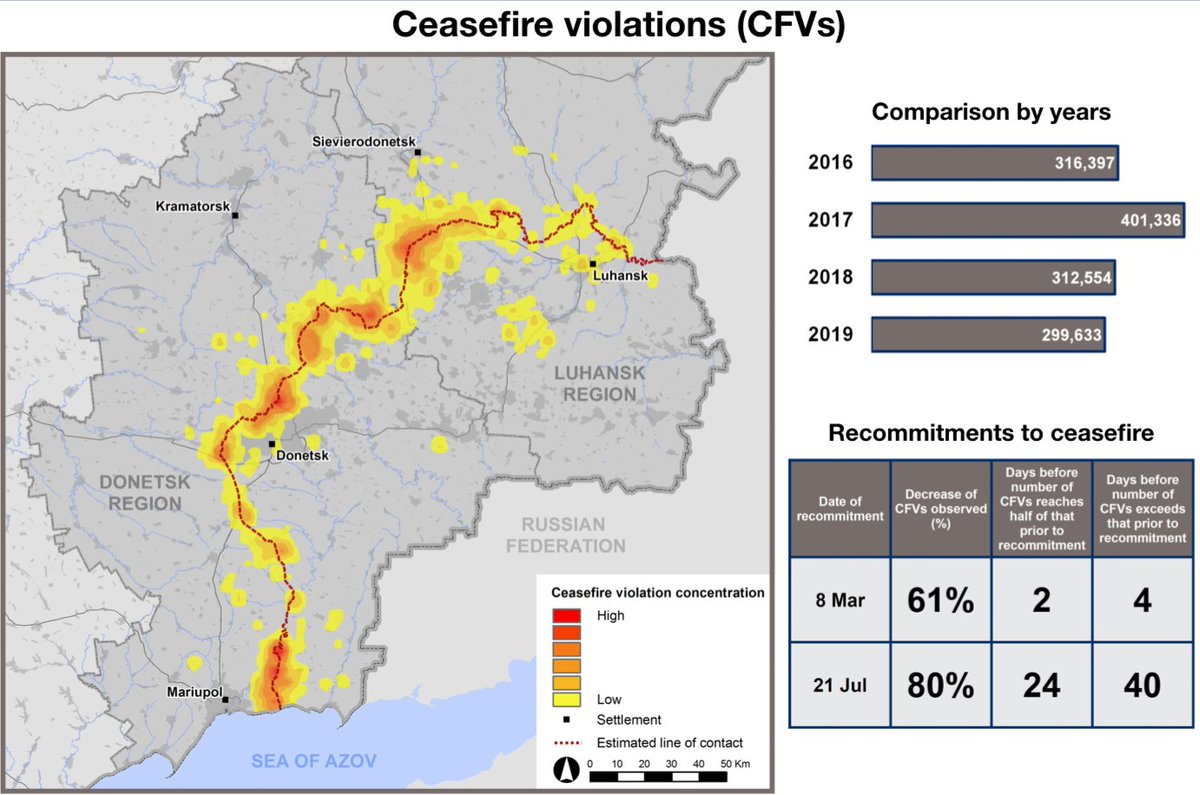
Ukrainian/Western commentators often assert that almost all ceasefire violations are on the pro-Russian side - but they are operating under a different understanding of the term.
What they *mean* is that day-to-day obligations not to shoot do not apply to Ukrainian forces when the other side is in such gross violation of Minsk’s withdrawal lines. And they mean that Ukraine has an absolute right to use force on its sovereign territory.
Ceasefire monitors do indeed observe most of the heavy-weapons violations on sep-held territory. They experience 90% of denials of access here too. Civilian casualties paint a more complicated picture. Below, also from OSCE:
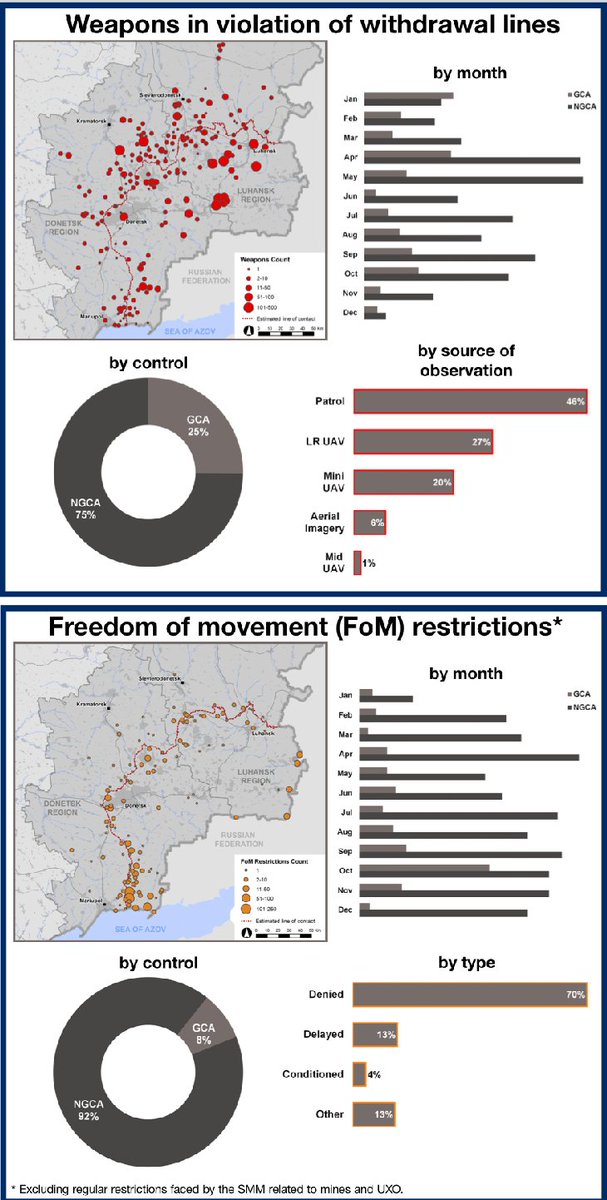
2/3 of civilian casualties occur in sep-held areas, where the frontline runs through densely-populated urban districts. The odds of shells or bullets striking civilians here are that much greater.
To get a sense of this, see map below from @InformNapalm. I'm not endorsing this source, but the map illustrates how urban settlements are clustered in the SE part of the region.
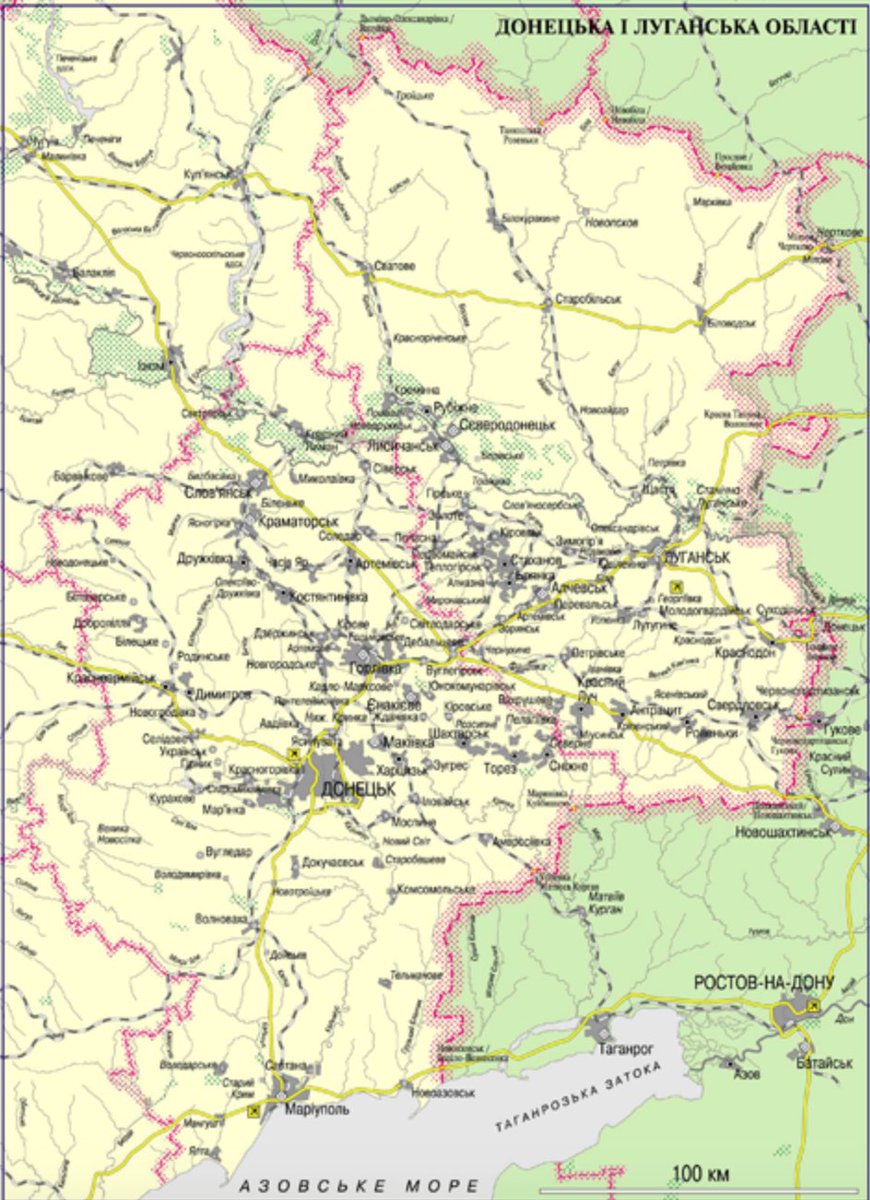
@InformNapalm The greater toll on civilians in sep areas is a dynamic of the war largely ignored in Ukrainian mainstream discourse, moreso in the West. Yet it is a central part of the sep/Russian narrative. It is hard to imagine true reconciliation without confronting it.
Frontline dwellers – up to 200,000 on the gov side and 400,000 on the other- often blame both sides. Many do not take kindly to exhortations to look at the big picture - that none of this would be happening if Russia had not invaded.
Nor do they welcome observations that pro-RU media has a near monopoly where they live, and may shape their views. Nor do they welcome the suggestion that if they were truly "innocent" victims, if they were "true Ukrainian citizens", they would have left.
They would have left and gotten themselves to safety, where they could see things as they are - and stop blaming both sides. (And stop taking food aid, pensions, etc from both sides too.)
And stop speaking "the language of the aggressor". And take some responsibility for voting in the 2014 pro-Russian referendums, which got us into this mess.
And they would stop being so “proletarian”- the combativeness, the single-minded focus on protecting what’s theirs instead of building something better, the overpalatalized e’s, the normalization of alcoholism and unwed motherhood, the Oriental carpets on walls.
People don’t want to hear this - any more than someone in North Philly who just had a relative shot wants to hear about a "culture of violence in the African American community", or be exhorted to stop "blaming society/cops/guns" for their loss.
Ppl in Donbas don't want to hear about their "complicity", any more than someone in a pro-Brexit precinct in the North with no young people left wants to hear that they've joined forces with imperialist crooks in the southeast to plot their own demise.
Or any more than someone in a dying coal town in West Virginia’s poorest county - whose public health stats incidentally, mirror Donbas - wants to hear that their inaccess to healthcare is their own fault b/c they voted for Trump. bit.ly/2vznOV5
Donbas civilians don’t want to hear how this "kind of their fault" … any more than Kyiv wants to hear how it’s pushing Donbas away, when *they* were invaded.
Yes, these are flawed analogies. (Also, I don’t draw a moral equivalency between support for a racist and being a victim of gun violence.) But they have value.
People ask why I so preoccupied with the social aspects of this war, when its defining elements are so clearly geopolitical. It’s because I see such strong parallels with crises in my two countries of citizenship (US/UK) – crises in which Russia is a bit player.
These flawed analogies capture common threads in all these crises, and get at some basic truths. First, you cannot change minds or behavior without empathizing with the other side's experiences, and validating them.
This need to validate applies to the local dynamics of this conflict, like treatment of Donbas residents — but also to one of its root causes: Russia’s belief that the West holds it to skewed standards and views its people with contempt.
Second - there is a fine line between examining a party’s possible complicity in their woes, and indulging in contempt towards them. Crossing the line plays into the aggressor’s hands.
This goes for analyses of Kyiv and its tactical failures in this conflict. As someone who lives here and sees these failures up close, I have to watch myself on this point! It also goes for views on Donbas residents.
There’s particular danger in losing empathy for a victim whom the aggressor claims to speak for, even as he arguably ruins their lives – whether that's "disloyal" Donbas civilians, or the proverbial uninsured Fox News watchers.
We sometimes act like expressing contempt for these people is the same as resisting the aggressor. It’s the opposite.
It strengthens the aggressor, allowing him to position himself as the sole champion of a stigmatised group. And yes, we are talking about bullies who will take nearly any statement or act, and twist it for propaganda purposes.
Anyone who speaks their truth risks providing propaganda fodder. But we can reduce this risk by drawing a clear line between righteous anger and contempt/class prejudice.
There is some (sort of) good news. Civilian casualties in Donbas have fallen. Acc to UN, the total civ death toll > 3,344 as of Dec 2019; most were killed in 2014-2015. 2017 saw 117 civilians killed and 487 injured, 2018 – 55 killed, 226 injured, 2019- 27 killed, 140 injured.
Military casualties have dropped less dramatically. UN puts total deaths at 9,750 as of 11/2019: 4100 on gov’t side, 5,650 on pro-RU side. Casualties among army fell 44% in 2018 to about 110 acc. to gov stats, and held steady in 2019. Actual losses may be considerably higher.
RU-backed forces’ losses were almost certainly much higher, as they have been throughout the war - but they don’t publicise stats.
On both sides, the vast majority of fighters killed are Ukrainian citizens. And on both sides, the number of non-combat casualties – soldiers dying from illness, fights, suicide – rivals the number of combat casualties.
Why casualties are down is a matter of debate: is it because, as some here argue, Ukrainian troops have controlled the frontline since 2017? Because of the US Javelins sitting in west Ukraine? Because Moscow exercises strict control of the sep troops?
What the relatively low casualties in Donbas mean is that the temperature of the war is low enough for – tah-dah – Dialogue! Yes, there is still no end in sight, but we can still talk about how people are going to live together – now, and when the war ends.
Dialogue is in vogue. Excellent grassroots dialogue projects have functioned in Ukraine for years, along with several international platforms.
But dialogue initiatives have proliferated since Ze's election – partly bc various organisations believed his win was a new opening, and partly bc he and his team have talked up the idea.
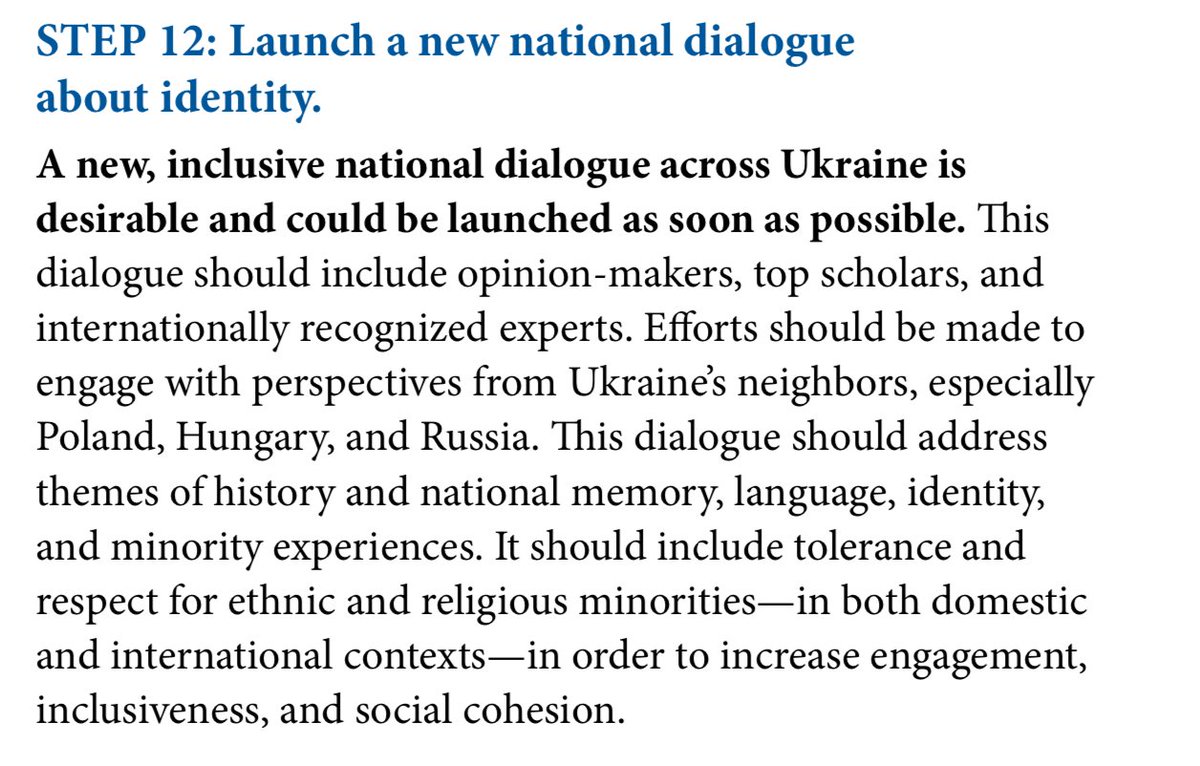
See, for example, Step 12 (below) in the controversial document put out by EASLG Friday. bit.ly/38yVKjg. And then this weekend, Security Council advisor Serhiy Sivokho announced he’s be presenting a national dialogue platform on the 19th.
As the idea of dialogue becomes more mainstream, backlash to the concept grows fiercer.
An advisor to one of Ukraine’s most powerful pols told us recently of his concern about talk of dialogue in international and domestic circles. “We have all long ago agreed amongst ourselves. We need to return our territory, and then work with that sick -- sick -- population.”
@AtlanticCouncil released a doc signed by US policy veterans – some of whom I greatly respect – denouncing EASLG's Step 12: Ukrainians are *already* united in their pro-Western aspirations - so we are told. The proposal is “an invitation to Russia to help define Ukraine”.
In Ukraine, prominent pro-Western politicians, civic activists, and media, have called the Step 12 “a provocation” and “dangerous”. Here’s the thing: plenty of Ukrainians believe they need internal dialogue, badly.
As an acquaintance from Shakhtarsk put it, when she hears people deny the need for intra-Ukrainian dialogue, she assumes they’ve never really spoken to anyone from the sep-held areas. (Shakhtarsk, which translates as "Minersville", is held by the "Donetsk People's Republic".)
Calling for dialogue is not inherently pro-Putin, any more than wanting to tackle wealth inequality is pro-Bolshevik. Or, to ground our analogies in the present, worrying about poverty in Venezuela makes you pro-Maduro.
I know people who were dreaming of Putin’s demise when some of those denouncing the Munich document were only vaguely aware of his existence – who feel strongly that Ukraine needs internal dialogue.
My friend from Donetsk has a breakdown nearly every time she speaks to her parents: “they ruined my life” by voting in the pro-RU referendum in 2014. Tell her everyone in Ukraine agrees on the country’s orientation. Are her parents no longer part of Ukrainian society?
Fix the geopolitical and the social will follow, people argue: her parents are brainwashed and their views will shift once Ukraine regains that territory – so focus solely on getting Russia out. But her parents might be dead by then. (At 70, her dad already defies statistics.)
And no, that won’t mean fewer “sick people” to work with, it will mean that a generation has come of age with no memory of life in a united Ukraine.
I believe a peaceful, internationally- administered, ideologically delicate return of these areas to Ukrainian control would reduce social tensions. But we have to consider that these tensions may add an additional obstacle to such a solution.
Social resentments underpin some opposition to disengagement, for example. An activist in Shchastye told me recently that she feared disengagement and the reopening of the bridge linking the isolated town to Luhansk. “I don’t want all that trash coming over here."
In 2017, a woman working with frontline families told me why she didn’t want reintegration. “These are people with a minimum level of human development, people raised by their TVs. Okay, so we live together, then what? We’re trying to build a completely new society.”
She was a hardworking, dignified person who came by these views honestly. So are the many other people I know with similar views. People have a lot of anger to work through. Would fixing the security situation ease this anger? Almost certainly - but it won’t erase it.
Ukraine’s neighbours have issues to work through too – clearly. Which is why I like Point 12 of the “Twelve Steps” document. @NTI_WMD @theELN @Russian_Council @MunSecConf
The Atlantic Council and others argue Point 12 of the invites Russian meddling. I can’t speak to whether any of the signatories had this as an ulterior motive.
To me, the wording implicates Russia. “Efforts should be made to engage with perspectives from Ukraine’s neighbours, especially Poland, Hungary, and Russia.”
Could such an initiative be instrumentalised by pro-Kremlin figures with an axe to grind? Absolutely. Those involved should know what to look out for.
The truth is, Ukraine and Russia need to talk about their respective identities. This will help Russia, and thus Ukraine. Arguably, if Russia’s leaders weren’t so painfully insecure in their own identity, they wouldn’t have invaded Ukraine.
Structured dialogue is a lot more complicated that sitting down and talking out differences. It is a long, drawn-out, often painful process that can backfire if executed poorly.
It won’t end the war. But it will do a lot more good than endlessly denying the truth that people who live through trauma have issues. And countries full of people – or led by people - with unaddressed issues do not develop peacefully.
CORRECTION I misstated what Minsk II says about withdrawal lines. Here's what it actually says: