The state of Madhya Pradesh, the 2nd largest Indian state by area, will have its assembly elections on Nov 28
This is a fine occasion to reflect on the history of the territory that constitutes Madhya Pradesh today
An under-discussed and an under-appreciated state
This is a fine occasion to reflect on the history of the territory that constitutes Madhya Pradesh today
An under-discussed and an under-appreciated state
There is a tendency to think of Madhya Pradesh as an "artificial entity" - culturally not dissimilar to the rest of North India. A state that is not worth our attention
But to my mind, that angle has been overdone and MP remains woefully under-studied
But to my mind, that angle has been overdone and MP remains woefully under-studied
When we think of Madhya Pradesh there are many things that strike us immediately
a) Its relatively low population density, along with Rajasthan, relative to the rest of North India. Some numbers
Population / sq km (2011)
MP : 236
India : 382
UP : 828
Kerala : 859
Bihar : 1102
a) Its relatively low population density, along with Rajasthan, relative to the rest of North India. Some numbers
Population / sq km (2011)
MP : 236
India : 382
UP : 828
Kerala : 859
Bihar : 1102
b) Madhya Pradesh's geography also marks it out among all Indian states, particularly when compared to the rest of the North Indian plain.
Forests account for roughly 31% of the state's area. This is in sharp contrast for instance to say the corresponding figure of 7% in UP
Forests account for roughly 31% of the state's area. This is in sharp contrast for instance to say the corresponding figure of 7% in UP
c) Much of Madhya Pradesh is a plateau as it is home to the Vindhya and Satpura ranges. In contrast to the plains of UP, Bihar, and Punjab
Next let's move to demographics and politics
Next let's move to demographics and politics
d) Madhya Pradesh is perhaps the most Hindu of all Indian provinces. With 91% of its population adhering to Hinduism
But it is also worthwhile to note that MP is home to a very large proportion of the "adivasi" population. The Scheduled Tribes account for 21% of MP's 73MM
But it is also worthwhile to note that MP is home to a very large proportion of the "adivasi" population. The Scheduled Tribes account for 21% of MP's 73MM
e) In terms of its politics, MP to this day remains a bipolar polity with power keenly contested by Congress and BJP
This is in sharp contrast to other Northern States like UP / BIhar, where caste based parties play a major major role (Eg: SP, BSP, RJD)
This is in sharp contrast to other Northern States like UP / BIhar, where caste based parties play a major major role (Eg: SP, BSP, RJD)
f) MP has seen far less iconoclasm over centuries compared to other states. Many of the ancient pre-Islamic sites in North India (pre 12th cen) are to be found here
Khajuraho
Bateshwar temples
Temples at Amarkantak
Sanchi Stupa
Sonagiri Jain temples
Images : wikipedia
Khajuraho
Bateshwar temples
Temples at Amarkantak
Sanchi Stupa
Sonagiri Jain temples
Images : wikipedia


So there is a case for Madhya Pradesh's exceptionalism which is seldom made by anyone.
But what is this territory's place in Indian history? When does the region first make its appearance in the annals of India? Let's explore
But what is this territory's place in Indian history? When does the region first make its appearance in the annals of India? Let's explore
Today we tend to think of Madhya Pradesh as the "Center" of India geographically
But in the Vedic as well as early classical period before the common era, the VIndhyas were not viewed as the geographic centroid but the southern boundary of Aryavarta
Illustration: wikipedia
But in the Vedic as well as early classical period before the common era, the VIndhyas were not viewed as the geographic centroid but the southern boundary of Aryavarta
Illustration: wikipedia
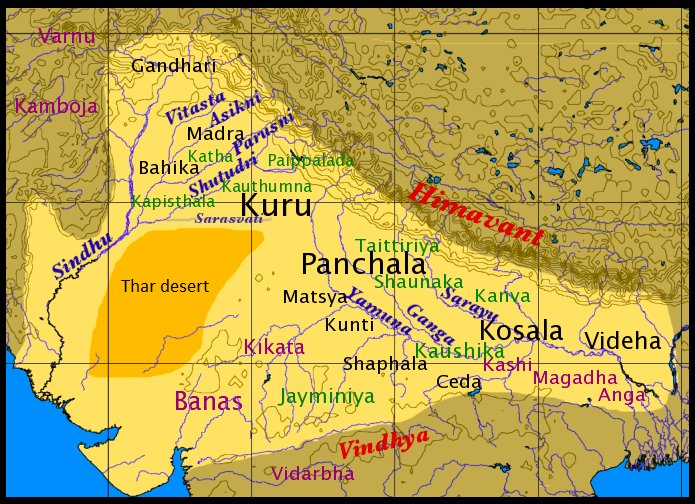
Back in the Vedic and even Epic period the term "Madhya Desha" referred not to the area that constitutes Madhya Pradesh today, but to the Ganga - Yamuna Doab - the great plains of present UP and Bihar
The Vindhya territory marked the southern frontier of the Aryan cultural zone
The Vindhya territory marked the southern frontier of the Aryan cultural zone
Nowhere is this more evident than in the Manu-smriti, which clearly is a post-Vedic, post Epic period text (maybe in the centuries just preceding the common era). But even in this text, Aryavarta ends with the Vindhyas
आ समुद्रात् तु वै पूर्वादा समुद्राच्च पश्चिमात् ।
तयोरेवान्तरं गिर्योरार्यावर्तं विदुर्बुधाः
"The country extending as far as the Eastern Ocean and as far as the Western Ocean, and lying between the two mountains (Himalaya and VIndhya),—the learned know as ‘Āryāvarta.’
तयोरेवान्तरं गिर्योरार्यावर्तं विदुर्बुधाः
"The country extending as far as the Eastern Ocean and as far as the Western Ocean, and lying between the two mountains (Himalaya and VIndhya),—the learned know as ‘Āryāvarta.’
Having said that Aryanization of the Deccan had started happening even before the time of Manu Smriti. Even a territory to the south of the VIndhyas like "Vidarbha" features in the Mahabharata. Even very early Sangam literature in Tamil country already refers to Brahmins
Ofcourse during the classical period (by the time we reach about 3rd / 4th cen or so), Aryan culture had engulfed the whole of subcontinent and beyond.
Vindhya territory was now no more the southern frontier, but the geographical centroid.
Vindhya territory was now no more the southern frontier, but the geographical centroid.
But despite being viewed as the southern frontier, the Vindhya region and the territory just to its south played a major role in North Indian geopolity during the Vedic period
Major late Vedic kingdoms included
Chedi (modern Bundelkhand) (Shishupala of MB fame)
Avanti kingdom (modern Malwa) (with its two great cities of Ujjaini & Mahishmati)
Both kingdoms are mentioned in the 4th c BCE Buddhist text Anguttara Nikaya (in its list of 16 Mahajanapadas)
Chedi (modern Bundelkhand) (Shishupala of MB fame)
Avanti kingdom (modern Malwa) (with its two great cities of Ujjaini & Mahishmati)
Both kingdoms are mentioned in the 4th c BCE Buddhist text Anguttara Nikaya (in its list of 16 Mahajanapadas)
There is also a legendary kingdom of "Haihaya" with its capital at Mahishmati in modern MP that features in Mahabharata and Puranic literature. Possibly also belonging in some form to the Vedic period
Its major king was the great Kartavirya Arjuna
The Haihayas were most likely overthrown by Brahmins of the Bhargava clan - as indicated by the legend of Parashurama avenging his father Jamadagni's death by killing the Haihaya king - Kartavirya Arjuna
The Haihayas were most likely overthrown by Brahmins of the Bhargava clan - as indicated by the legend of Parashurama avenging his father Jamadagni's death by killing the Haihaya king - Kartavirya Arjuna
In later periods, the territory of what we call MP today, became a part of the great Mauryan Empire which united much of India.
Ashoka was in fact the governor of Ujjain as per some Ceylonese Buddhist sources, during his father Bindusara's reign
Ashoka was in fact the governor of Ujjain as per some Ceylonese Buddhist sources, during his father Bindusara's reign
He married a merchant's daughter "Devi" during his stay in that region. The lady was a native of Vidisha (Besnagar in modern MP)
Vidisha a few centuries later became home to the famous Heliodorus pillar - erected in honor of vAsudeva by a Greek ambassador to Shunga court)
Vidisha a few centuries later became home to the famous Heliodorus pillar - erected in honor of vAsudeva by a Greek ambassador to Shunga court)
In the early centuries of the common era, many parts of Malwa actualy came under the rule of the Deccan based kingdom of Shatavahanas, during the reign of the great Gautamiputra Satakarni
This distinguishes the Malwa region from the rest of north India in that it was often under the rule of Deccan based kingdoms - first briefly during Satavahana period, and later during Rashtrakuta period
In the height of the classical era (3rd - 5th cen), much of modern MP came under Guptas - an empire headquartered in Pataliputra
Then there was a period of chaos. A period of repeated invasions of Shweta Huna foreigners (from the North West), causing the decline of the Guptas
Then there was a period of chaos. A period of repeated invasions of Shweta Huna foreigners (from the North West), causing the decline of the Guptas
This was when the Malwa reglion came to the fore, and did BhAratavarsha a great service
The great Malwa king Yashodharman of Aulikara dynasty was instrumental in defeating the Huna warlord - MihirAkula (known in later Persian tradition as Mehr Gul), and driving Huns out of India
The great Malwa king Yashodharman of Aulikara dynasty was instrumental in defeating the Huna warlord - MihirAkula (known in later Persian tradition as Mehr Gul), and driving Huns out of India
Who were the Aulikara kings? Were they just feudal lords owing their allegiance to Guptas? Or were they independent kings? I am not sure.
But Yashodharman's place (500 to 550 AD roughly ) in Indian history should be very exalted.
But Yashodharman's place (500 to 550 AD roughly ) in Indian history should be very exalted.
His great victory is commemorated in the great Mandsaur stone inscription in western Madhya Pradesh today

There is also a separate Mandsaur pillar inscription which explicitly declares Yashodharman's victory over Mihirakula (which you don't find in the stone inscription)

But the persistent invasions of the White Huns and the Alchon Huns did take a toll eventually leading to the decline of the Gupta empire in Northern India.
With the exception of pan-North Indian rule of Harsha, the region of MP during the centuries 7th to 9th, was influenced greatly by kingdoms to its south in the Deccan - particularly the Rashtrakutas
Post 9th century, the Rajput dynasts extended their sway over the regions of Malwa and Bundelkhand - the Paramaras in Malwa (Western MP) and the Chandelas in Bundelkhand (Northern / eastern MP)
Today we remember the Chandelas the best for the marvelous, if somewhat lurid, temples of Khajuraho in northern MP.
The Paramaras are remembered somewhat differently. Through the memory of a single individual - their greatest king - the erudite Raja Bhoja
The Paramaras are remembered somewhat differently. Through the memory of a single individual - their greatest king - the erudite Raja Bhoja
Bhoja ruled from his capital in Malwa - the town of Dhara nagara - known as Dhar today.
His reputation is one of the greatest among all Indian kings in our 3000+ years of history
His reputation is one of the greatest among all Indian kings in our 3000+ years of history
He was a veritable polymath, a great Shiva bhakta, a renowned warrior, a patron of the arts, and a fine litterateur himself.
While many works are attributed to him, the book he is best known for is "Shringara Prakasha" - a treatise on poetry and drama
While many works are attributed to him, the book he is best known for is "Shringara Prakasha" - a treatise on poetry and drama
Bhoja's influence was so great on succeeding centuries, that many a fine king in later years has attempted to emulate him.
The great Krishna Devaraya of Vijayanagara Kingdom in early 16th century fashioned himself as "Abhinava Bhoja" (the new Bhoja).
The great Krishna Devaraya of Vijayanagara Kingdom in early 16th century fashioned himself as "Abhinava Bhoja" (the new Bhoja).
Eventually the Delhi Sultanate did gain political control over these regions in the 13th/14th centuries.
Until the rise of the Mughals 2 centuries later, the sovereignty rested with the Sultanates of Malwa, Delhi and also the Hindu Tomara dynasty of Gwalior
Until the rise of the Mughals 2 centuries later, the sovereignty rested with the Sultanates of Malwa, Delhi and also the Hindu Tomara dynasty of Gwalior
The Mughals then ruled over the region for a good part of 2+ centuries. But after the fall of Aurangazeb, several Maratha dynasts became dominant
The Shindes (Scindias) of Gwalior
The Holkars of Indore (Malwa)
And at the NE and SW frontiers of the state you've Jhansi & Bhonsles
The Shindes (Scindias) of Gwalior
The Holkars of Indore (Malwa)
And at the NE and SW frontiers of the state you've Jhansi & Bhonsles
However the region in and around Bhopal was a separate princely state, ruled by Muslim dynasts.
It was founded in late 17th century. For much of the British period in the 19th century, this princely state was nominally reigned over by several Muslim Begums
It was founded in late 17th century. For much of the British period in the 19th century, this princely state was nominally reigned over by several Muslim Begums
As far as the rest of the region is concerned, the Maratha influence waned near-terminally, after the great Anglo-Maratha war of 1818, which was disastrous for the Marathas.
By the mid-to-late 19th century, much of what we call Madhya Pradesh became to be known by two provinces -
Central Provinces
Central India Agency (comprising of the different princely states owing allegiance to the British)
Central Provinces
Central India Agency (comprising of the different princely states owing allegiance to the British)
When India turned independent, we ended up with a plethora of new states in the region -
Central Provinces was rechristened Madhya Pradesh
While the princely states in the Central India Agency were split into three states - Madhya Bharat, Vindhya Pradesh, Bhopal
Central Provinces was rechristened Madhya Pradesh
While the princely states in the Central India Agency were split into three states - Madhya Bharat, Vindhya Pradesh, Bhopal
It was only in 1956 with the lingual reorganization of states, that the predominantly Hindi speaking portions of all these different states were unified and constituted the new "MP" - the largest state in India
The Marathi speaking regions of Vidarbha were ceded to Bombay state
The Marathi speaking regions of Vidarbha were ceded to Bombay state
How has the politics of the region shaped up?
Perhaps in part owing to its legacy of princely rule right up to the 20th century, Madhya Pradesh politics has been marked by remarkable continuity and political dynasties
Perhaps in part owing to its legacy of princely rule right up to the 20th century, Madhya Pradesh politics has been marked by remarkable continuity and political dynasties
The Congress Party has retained its influence in Madhya Pradesh for far longer than in most other parts of North India, excepting Rajasthan.
The curious non-emergence of localized caste based parties in Madhya Pradesh is also very striking - in sharp contrast to UP and Bihar
The curious non-emergence of localized caste based parties in Madhya Pradesh is also very striking - in sharp contrast to UP and Bihar
Here's an examination of Congress vote shares in MP over the years in Vidhan Sabha elections -
1957: 49.8%
1962: 38.5% !!!!
1967: 40.6%
1972: 47.9%
1977: 35.9%
1980: 38.5%
1985: 48.9%
1990: 33.4%
1993: 40.7%
1998: 40.6%
2003: 32.4%
2008: 32.4%
2013: 36.4%
1957: 49.8%
1962: 38.5% !!!!
1967: 40.6%
1972: 47.9%
1977: 35.9%
1980: 38.5%
1985: 48.9%
1990: 33.4%
1993: 40.7%
1998: 40.6%
2003: 32.4%
2008: 32.4%
2013: 36.4%
Madhya Pradesh, like most other parts of Northern India, reacted viscerally to the Ayodhya Movement. No doubt.
Having said that the Jana Sangh has always had a fairly strong presence in MP. So it is worthwhile to track the vote shares of Jana Sangh (BJS) and BJP over the years
Having said that the Jana Sangh has always had a fairly strong presence in MP. So it is worthwhile to track the vote shares of Jana Sangh (BJS) and BJP over the years
BJS / BJP vote shares in assembly elections (BJP post 1984)
1957: 9.9%
1962: 16.7% !!!!
1967: 28.3%
1972: 28.6%
1977: NA (47.3% for Janata Party)
1980: 30.3%
1985: 32.4%
1990: 39.1%
1993: 38.8%
1998: 39.3%
2003: 37.6%
2008: 37.6%
2013: 44.9%
1957: 9.9%
1962: 16.7% !!!!
1967: 28.3%
1972: 28.6%
1977: NA (47.3% for Janata Party)
1980: 30.3%
1985: 32.4%
1990: 39.1%
1993: 38.8%
1998: 39.3%
2003: 37.6%
2008: 37.6%
2013: 44.9%
So what you see is a very healthy and significant right wing presence right from the inception of the state
SInce 2003, the BJP has been in power in the state - for over 15 long years (mostly under the helm of Shivraj Singh Chauhan)
A very remarkable achievement in 21st century multi-polar Indian politics
A very remarkable achievement in 21st century multi-polar Indian politics
Who have been some of the leading lights of MP politics over the years.
As remarked, the politics in the state has long had a dynastic feel to it.
As remarked, the politics in the state has long had a dynastic feel to it.
The state's first CM was Pandit Ravi Shankar Shukla, a stellar personality from the decades of the freedom movement
He was succeeded by one Mr Bhagvant Rao Mandloi of Khandwa, CM for a brief period
Also strangely a recipient of Padma Bhushan. Not sure about the citation
He was succeeded by one Mr Bhagvant Rao Mandloi of Khandwa, CM for a brief period
Also strangely a recipient of Padma Bhushan. Not sure about the citation
He was succeeded from 1957 to 1962 by Kailash Nath Katju, a Kashmiri Pundit, whose family included Dewans in one of the princely states
Next came the distinguished Dwarka Prasad Mishra, a literary figure, father of Brajesh Mishra, the National security advisor in Vajpayee govt
Next came the distinguished Dwarka Prasad Mishra, a literary figure, father of Brajesh Mishra, the National security advisor in Vajpayee govt
In the early 70s, the CM was Shyam Charan Shukla, the son of Ravi Shankar Shukla whom we have alluded to.
CMs in the 80s included Sundarlal Patwa, Motilal Vora, Arjun Singh - all Congressmen
Digvijay Singh, who was CM for much of the 90s was himself of princely lineage
CMs in the 80s included Sundarlal Patwa, Motilal Vora, Arjun Singh - all Congressmen
Digvijay Singh, who was CM for much of the 90s was himself of princely lineage
The two most recent CMs, Uma Bharti and Shivraj Singh Chauhan, mark a break from the past, in that they are from humbler backgrounds relative to the nepotistic high connections that characterize many of the state's early politicians
So that's the end of the thread.
This is a fascinating region of the country, that is much overlooked. Many of its ancient towns have exerted a great influence on Indian life over millennia - Ujjaini, Mahishmati, Dharanagara
Today, we tend to not think of them much
This is a fascinating region of the country, that is much overlooked. Many of its ancient towns have exerted a great influence on Indian life over millennia - Ujjaini, Mahishmati, Dharanagara
Today, we tend to not think of them much
It is also a state that has proved exceptional in its politics. Often deferring to dynastic leaders. And often surprising us with the curious lack of anti-incumbency in its politics
Why is that the case needs to be a subject of some investigation.
Post script : References for this thread are mostly from wiki and the election commission website
Post script : References for this thread are mostly from wiki and the election commission website
Post-script : A correction - In one of the later tweets, Sundarlal Patwa was mistakenly referred to as a Congressman. He is ofcourse from the BJP.
Thanks
Thanks
Postscript 2 : One of the personalities I regret not mentioning while discussing Marathas in MP is the great Ahilyabai Holkar
She reigned from Maheshwar near Indore for nearly 30 years from 1767 to 1795.
A very central figure in the Hindu revivalism of 18th century
She reigned from Maheshwar near Indore for nearly 30 years from 1767 to 1795.
A very central figure in the Hindu revivalism of 18th century